

Quality Water Management and Uninterrupted Service in Hotels
Mayıs 4, 2026
In Which Scenarios Is a Mobile Water Treatment Unit Necessary?
Mayıs 27, 2026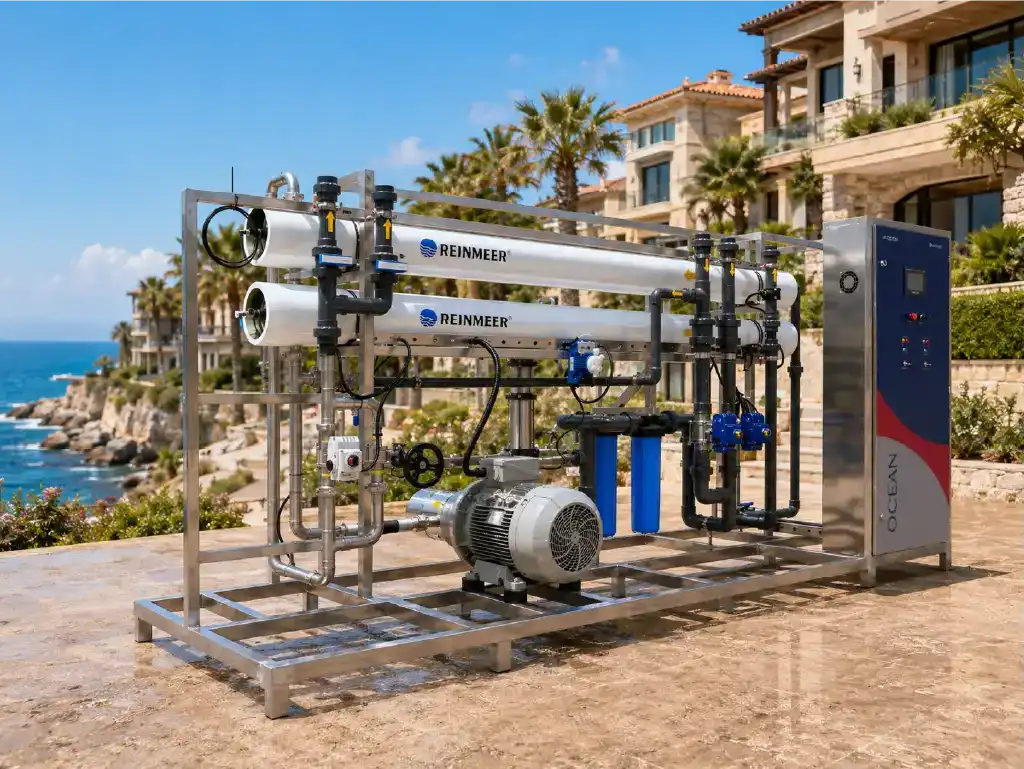
For residential sites, summer housing projects, detached villas, and small settlements located in coastal regions, continuous access to clean water is not only a matter of comfort; it is also a critical need for sustainable living and safe facility management.
Especially during the summer months, population growth, insufficient municipal water supply, rising water transportation costs, and seasonal changes in existing resources make alternative water production solutions much more valuable. At this point, Seawater Desalination systems offer a strong, controlled, and long-term solution for living areas close to the coast. A Seawater Desalination investment also supports the continuity expected from modern coastal living.
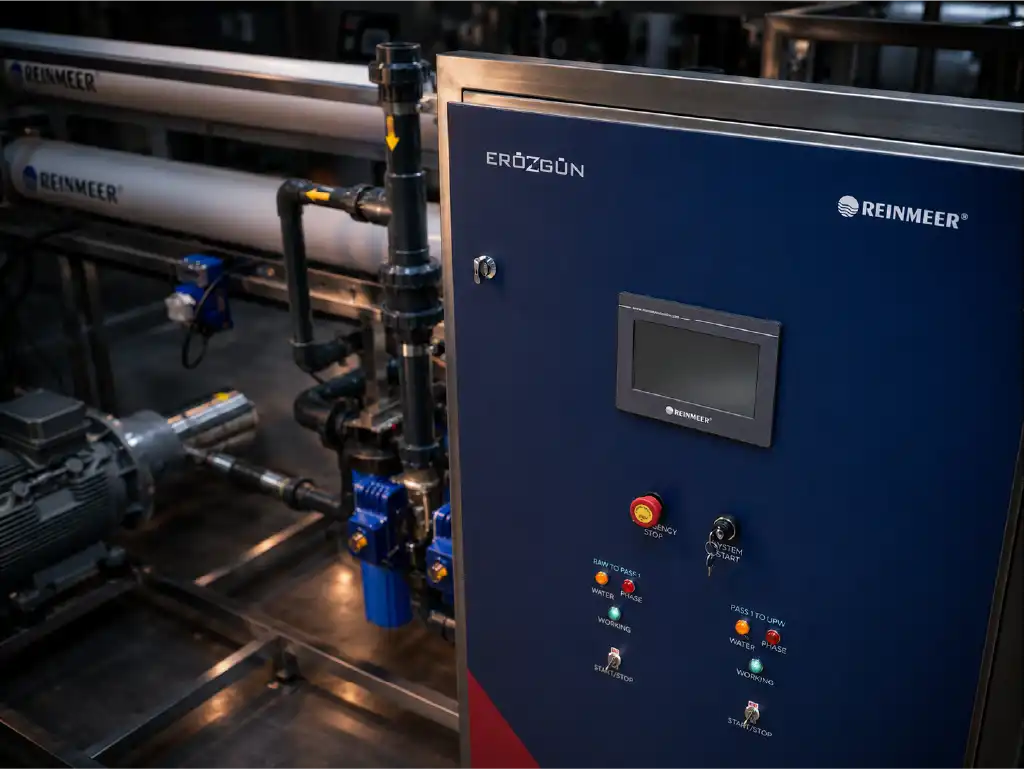
A centralized Seawater Desalination system treats seawater through technical processes and brings it to a usable quality level, allowing it to meet the shared water needs of multiple residences on a regular basis. Seawater Desalination systems installed with the right capacity, suitable pretreatment, high-quality equipment selection, and professional project planning reduce the dependence of sites and villas on external water sources while ensuring water continuity in daily life. In this guide, you can examine in detail which areas a centralized Seawater Desalination solution is suitable for in coastal regions, which technical criteria should be considered when selecting a system, and what long-term advantages it can provide.
Which Living Areas Are Suitable for a Central Seawater Desalination System?
A central Seawater Desalination system is especially suitable for living areas where access to municipal water is limited, existing water resources are insufficient in terms of quality or quantity, consumption rises suddenly during the summer season, and shared infrastructure is used.
In coastal regions, many residential projects operate with low occupancy during certain parts of the year but are exposed to much heavier use in the summer months. This fluctuation can cause problems in traditional water supply methods, such as pressure drops, interruptions, the need to transport water by tanker, or insufficient storage capacity.
A centralized Seawater Desalination infrastructure helps manage this variability in a more planned way. The system can be designed around one main production unit to serve a residential site, villa group, social facility, landscape area, pool support water, technical water use, and, when necessary, indoor residential use.
The main goal here is to create a central Seawater Desalination system that is calculated according to actual demand, monitored, and maintained regularly instead of installing small and uncontrolled solutions for each structure separately. This Seawater Desalination approach simplifies technical management and makes long-term operating expenses more predictable.
Summer Sites and Collective Housing Projects with Seawater Desalination Needs
Summer sites and collective housing projects are among the living areas that can benefit most from central Seawater Desalination systems. In these projects, water demand is not limited only to indoor residential use. Shared gardens, swimming pools, shower areas, landscape irrigation, security units, social facilities, and cleaning operations also increase total water consumption significantly.
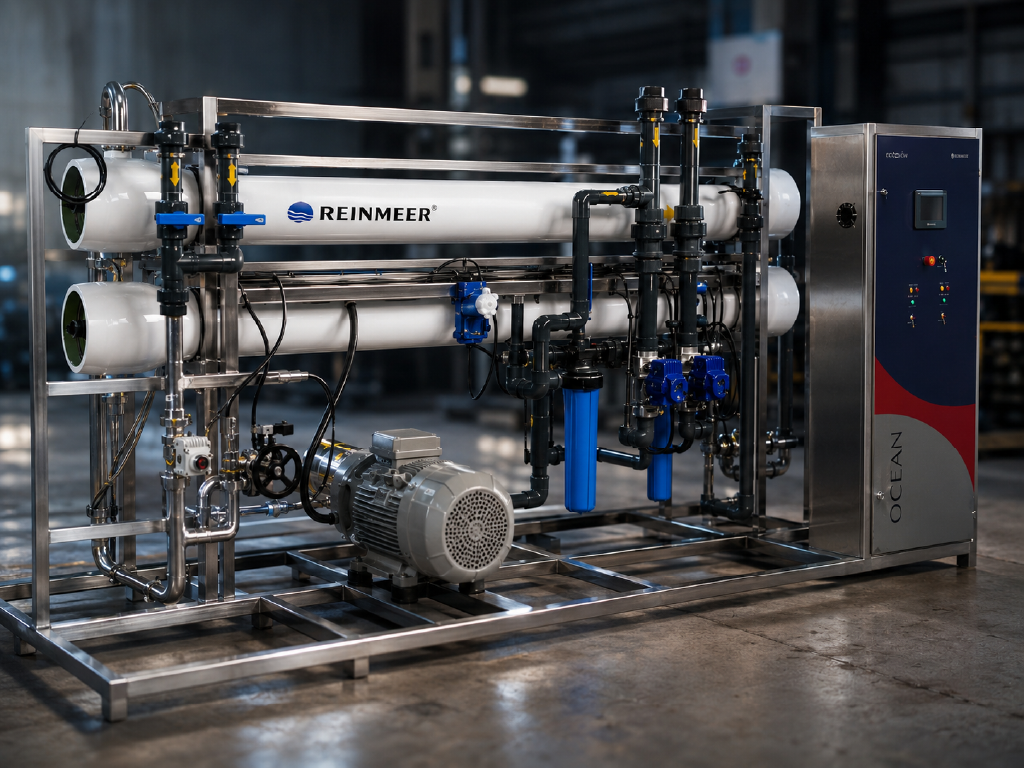
In addition, seasonal density is highly visible in summer regions. Consumption that remains low during winter can increase several times in summer as the number of guests and property owners rises. For this reason, system capacity should be evaluated not only according to average consumption but also according to peak-season scenarios.
A properly designed Seawater Desalination solution allows site management teams to manage water supply in a more planned way. Thanks to the centralized system, water production, storage, and distribution can be monitored from a single technical center.
This supports regular maintenance processes, water quality control, and faster response in case of possible failures. Especially in large-scale sites, creating a shared Seawater Desalination infrastructure instead of installing separate systems for each block or residence can be a more efficient model in terms of technical integrity and cost control.
Detached Villas, Small Settlements, and Seawater Desalination Solutions
Seawater Desalination systems can also provide an effective solution for detached villas, boutique holiday settlements, and small coastal projects made up of several residences. Although water demand may seem lower in these areas, the usage profile can be highly variable.
When garden irrigation, pool make-up water, cleaning, showers, kitchens, and technical room consumption are combined in a villa, daily water demand may be higher than expected. In addition, well water may be available in some areas, but it may not be suitable for direct use due to salinity, hardness, iron, manganese, or microbiological risks.
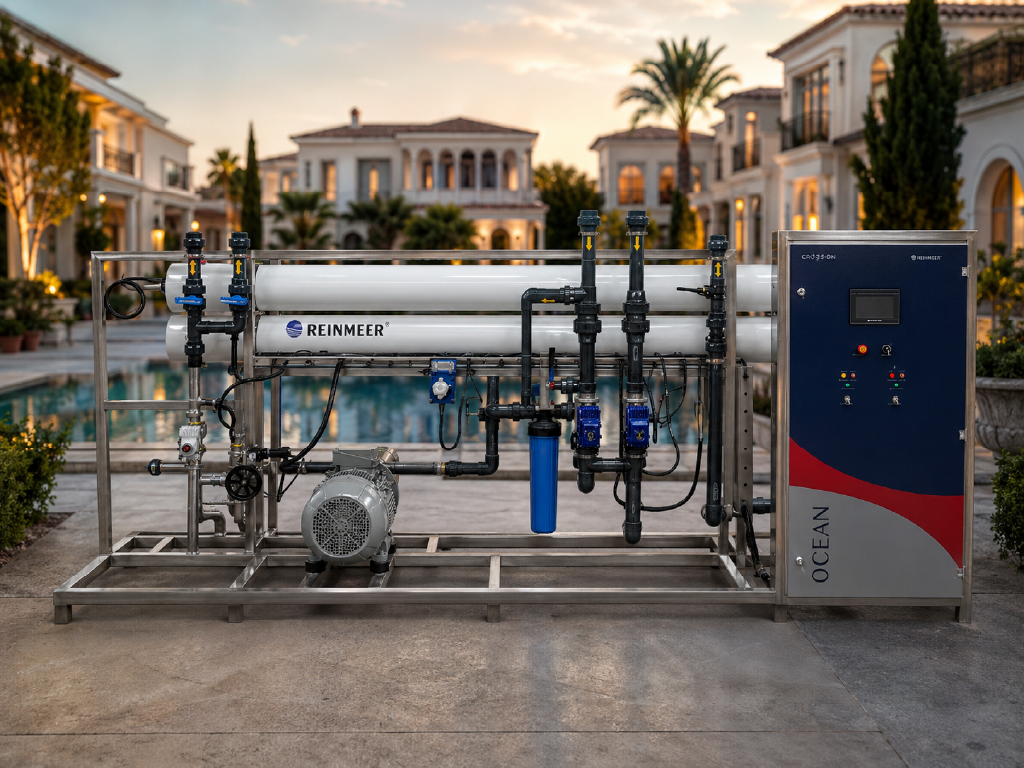
In areas close to the sea, seawater intrusion into groundwater is also a common issue. Therefore, not only the presence of water but also the quality of water must be evaluated. A small-scale central Seawater Desalination system can be designed to meet the shared needs of multiple villas and distribute water regularly to each structure.
This makes users less dependent on tanker water, uncertain sources, or seasonal municipal supply performance. For villa-focused systems, compact equipment placement, quiet operation, low maintenance requirements, automation capability, and energy consumption should be considered carefully. A well-planned Seawater Desalination system is an important infrastructure investment that supports both comfort and property value in small settlements.
Which Technical Criteria Should Be Evaluated When Selecting a Seawater Desalination System?
When selecting a Seawater Desalination system, it is not enough to look only at device capacity or initial investment cost. For the system to operate efficiently, the characteristics of the water source, consumption profile, storage infrastructure, energy demand, pretreatment needs, automation level, maintenance convenience, and distribution line must be evaluated together. Because seawater has high salinity and a variable mineral structure, every Seawater Desalination application requires a different engineering approach from standard drinking water treatment applications.
For this reason, reverse osmosis membrane quality, high-pressure pump efficiency, corrosion-resistant material selection, chemical dosing infrastructure, filtration stages, and control panel features play an important role in system selection. In coastal areas, the raw water intake point is also a critical issue.
The seawater intake structure must be designed by considering wave movements, suspended solids density, biological pollution, algae formation, and seasonal turbidity changes. In a professional Seawater Desalination project, the goal is not only to treat seawater, but also to ensure that the system operates throughout the year in a balanced, safe, and economical way.
Daily Consumption and Storage Tank Capacity in Seawater Desalination Projects
The first criterion to be evaluated in the design of a central Seawater Desalination system is daily water consumption. When making this calculation, the number of residences, water consumption per person, summer occupancy rate, guest density, pool volume, landscape area, shared area cleaning needs, and technical usage scenarios should be considered together.
For example, a calculation based only on the number of apartments may be insufficient, especially in summer sites. The same residence may be used by two people outside the season but by a much larger family during the summer period. Therefore, system capacity should be planned according to the demand of the busiest period rather than average consumption. Storage tank capacity is also an important part of system performance.
While the Seawater Desalination system operates at a certain production rate during the day, storage tanks balance consumption fluctuations. Water use may increase in the morning and evening, while pool or landscape use may intensify at certain times. If storage capacity is insufficient, the system may struggle to meet instant demand.
However, selecting an excessively large tank may cause water to remain stored for too long and make hygiene management more difficult. For this reason, treated water tank capacity, raw water tank capacity, and distribution pump capacity should be designed in a balanced way. A well-calculated Seawater Desalination infrastructure provides uninterrupted use while preventing unnecessary strain on equipment.
| Criteria to Evaluate | Why It Matters | Planning Impact |
|---|---|---|
| Number of residences and users | Determines total daily consumption | Ensures the correct Seawater Desalination capacity is selected |
| Peak-season density | Consumption increases during summer | Reduces the risk of insufficient production |
| Storage tank volume | Balances instant consumption fluctuations | Supports uninterrupted distribution |
| Raw water quality | Determines pretreatment needs | Affects membrane life and water quality |
| Energy consumption | Has a major impact on operating cost | Helps control long-term expenses |
Raw Water Quality, Salinity, and Pretreatment Needs
In Seawater Desalination systems, raw water quality is one of the main factors that determine system design. The salinity value, temperature, turbidity, organic matter load, amount of suspended solids, and biological pollution level of the seawater source are not the same in every region. Even along the same coastline, water quality may change depending on the season, currents, rainfall, harbor effects, or nearby settlement activity.
For this reason, a detailed water analysis must be performed before installation, and pretreatment stages must be determined according to these data. Pretreatment is one of the most important stages that protects reverse osmosis membranes. Sand filters, activated carbon filters, cartridge filters, antiscalant dosing, automatic flushing systems, and, when necessary, chemical conditioning applications help the system operate more steadily.
Insufficient pretreatment may cause membrane clogging, pressure increases, production loss, higher energy consumption, and increased maintenance costs. Therefore, in a Seawater Desalination project, it is necessary to focus not only on the main reverse osmosis unit but also on the entire process chain.
Salinity level directly affects high-pressure pump selection, membrane type, and energy consumption. High-quality material selection is also very important in Seawater Desalination against the corrosive effect of seawater. Stainless steel quality, suitable piping, chemically resistant equipment, and an automation system are essential parts of a long-lasting Seawater Desalination infrastructure.
What Are the Advantages of Using a Centralized Seawater Desalination System?
The most important advantage of using a central Seawater Desalination system is that it makes water supply more controlled, sustainable, and manageable. In coastal regions, water demand often increases seasonally, and existing infrastructure may not always meet this intensity. A centralized system allows a residential site or villa group to have its own water production source and reduces dependence on external suppliers. In addition, managing maintenance, monitoring, quality control, and energy use through a shared system can be more organized than managing many small independent systems.
When capacity planning is done correctly, a centralized Seawater Desalination infrastructure provides residents with more stable water pressure, consistent quality, and uninterrupted use. It also makes budget planning easier for site management teams. Cost items such as tanker water supply, unplanned maintenance, interruptions caused by failures, and inefficient equipment use can become more controllable with a properly engineered system. A centralized structure allows technical staff to monitor the system from one point, plan periodic maintenance processes, and evaluate performance data. This increases user satisfaction and supports the long-lasting operation of the infrastructure.
Independence Against Water Interruptions with Seawater Desalination
Water interruptions are one of the most important problems that directly affect quality of life, especially in summer regions. Problems such as reduced municipal pressure, insufficient resources, delays in tanker supply, or seasonal density can cause serious comfort loss for site and villa users. A central Seawater Desalination system provides strong independence against these risks. For coastal regions, the sea is a continuous and large raw water source. A properly designed system can process this source in a controlled way and produce the water required for daily use.
Of course, this independence does not mean unlimited or uncontrolled consumption. For the system to operate efficiently, consumption management, storage tank control, regular maintenance, and water quality monitoring must be carried out. However, when these processes are planned, a Seawater Desalination infrastructure provides a major advantage, especially during high season. Residents can meet their daily needs more securely without waiting for water to arrive or having to obtain water from external sources. In addition, the centralized system can also serve as an important backup source in emergency scenarios. During periods when municipal water is temporarily interrupted or its quality decreases, the treated water tank and production capacity help protect water continuity in the living area.
Long-Term Operating Cost Control in Seawater Desalination Systems
In many site and villa projects, water supply may initially appear to be only a monthly expense item. However, water transportation by tanker, dependence on external sources, tank cleaning, quality problems, unplanned failures, and additional costs caused by insufficient infrastructure can create a serious budget burden over the long term. A central Seawater Desalination system helps make these costs more predictable when the correct capacity and efficient equipment are selected. Although there is an initial Seawater Desalination investment cost, the system should be evaluated from a long-term perspective. Energy-efficient high-pressure pumps, quality membranes, a correct pretreatment setup, and automation-supported monitoring infrastructure help keep operating costs under control.
In addition, with the central maintenance model, filter changes, chemical consumption, membrane performance, and pump operation can be monitored regularly. This prevents unexpected failures and extends the service life of the system. One of the biggest mistakes in Seawater Desalination systems is focusing only on low initial investment cost. Cheap equipment or insufficient project planning can quickly return as high energy consumption, frequent maintenance needs, and low water quality. Therefore, the total cost of ownership should be considered, and the system should be planned not only for today’s needs but also for future usage intensity. From a long-term perspective, a central Seawater Desalination solution can be both an economical and strategic infrastructure investment for coastal living areas.
Why Is Proper Planning Important in a Central Seawater Desalination Project?
The success of a central Seawater Desalination project depends not only on installing the system but also on planning it correctly. Not every project in coastal regions has the same conditions. In some residential sites, access to the sea is easy, but the technical room area is limited. In some villas, consumption appears low, but seasonal demand increases due to landscape and pool use. In some regions, seawater quality is more stable, while in others, turbidity, algae growth, or organic load may be more intense. For this reason, site inspection, water analysis, consumption calculation, area evaluation, and energy infrastructure review should be performed before the project begins.
Details such as technical room layout, service access, drainage, ventilation, electrical panel, chemical storage area, and wastewater discharge point are important for trouble-free Seawater Desalination operation. When a Seawater Desalination system is professionally engineered, it not only meets today’s needs but also offers a more flexible infrastructure for future capacity increases or additional use demands. Therefore, site management teams, villa owners, and investors should prioritize engineering support when selecting a system. When a quality Seawater Desalination system is combined with the right capacity, suitable materials, and regular maintenance, it can operate reliably for many years.
If you are looking for a sustainable, controlled, and long-term water supply solution for a coastal residential site, villa group, or collective living project, a central Seawater Desalination system can be a strong investment alternative. A properly engineered system does more than produce water; it also supports the comfort, technical safety, and operational efficiency of your living area. When every step is evaluated professionally, from daily consumption calculations and raw water analysis to pretreatment design and storage tank capacity, water interruptions and dependence on external sources become much more manageable.
Tuna Desalination offers engineering-focused Seawater Desalination solutions suitable for the needs of coastal regions, serving residential sites, villas, hotels, and living areas of different scales. To get detailed information about project-specific capacity determination, technical analysis, system selection, and implementation processes, you can visit tunadesalinasyon.com. This allows you to plan a safer, more efficient, and more sustainable Seawater Desalination infrastructure that considers not only today’s water demand but also usage needs that may increase in the future. A central Seawater Desalination investment is a strong step for projects that want to preserve comfort in coastal living and make operating costs more predictable.