
How to Determine SWRO Membrane CIP Timing: Pressure, Flow and Salt Rejection Guide
Ağustos 17, 2026
When Should an SWRO Membrane Undergo CIP Cleaning? Performance Criteria Guide
Eylül 9, 2026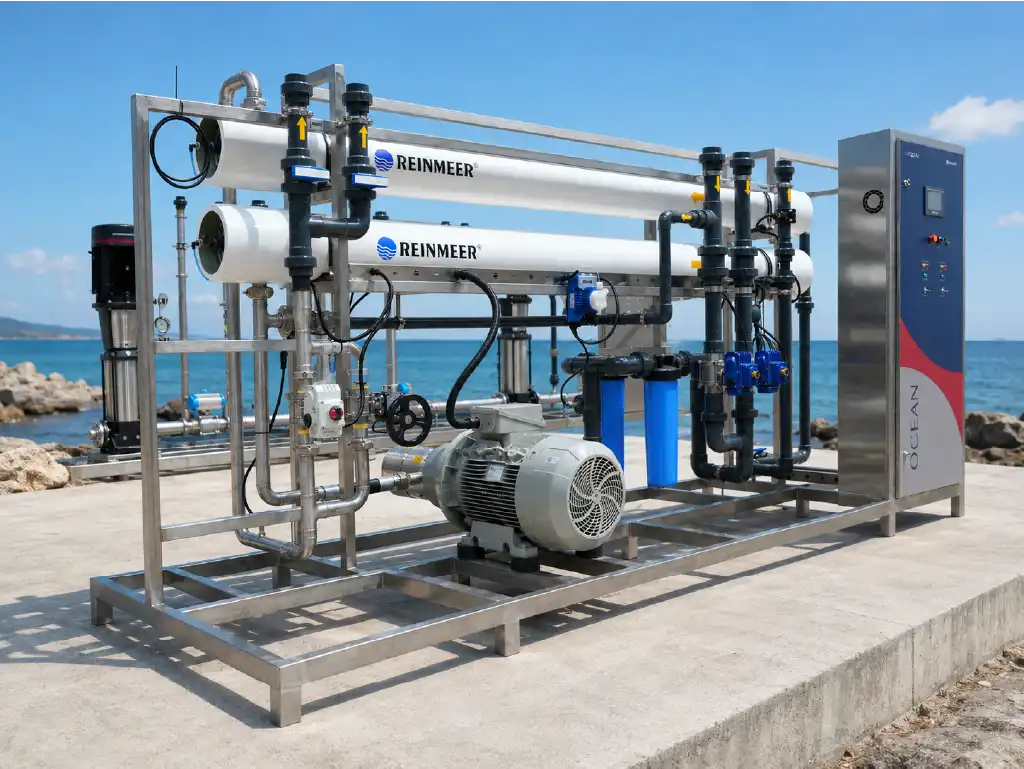
Even when membranes, high-pressure pumps, and energy recovery devices are correctly selected, an SWRO plant cannot deliver stable performance if feedwater reaches it with unpredictable flow or contaminant loading. The SWRO intake structure is therefore more than the first component on the shoreline. It influences pretreatment capacity, membrane-cleaning frequency, energy use, plant availability, and the long-term cost of every cubic metre of produced water. Choosing between an open-ocean intake and beach wells requires more than a comparison of construction prices. Marine conditions, coastal geology, required flow, seasonal water quality, environmental approvals, maintenance access, and future expansion must be assessed as one engineering problem.
An open-ocean system draws seawater directly through an intake head, screens, pumps, and a pipeline installed at a suitable depth. A beach well SWRO scheme collects seawater after it has travelled through coastal sediments into vertical, slant, or radial wells; the subsurface formation acts as a natural filter. Each SWRO intake structure offers a different advantage: direct intake can be easier to scale for high capacities, while a suitable beach-well field may provide lower turbidity and a more stable feed. Neither option is automatically superior. The correct choice must be demonstrated through site data, testing, permitting analysis, and a lifecycle comparison based on equal reliability targets.
Key Differences Between the Two Intake Methods
The first purpose of an SWRO intake structure study is to define the physical route and quality envelope of the feedwater. An open-ocean intake receives surface-water characteristics directly. Waves, currents, storms, algal blooms, nearshore activity, and sediment movement may change the feed rapidly. A beach well draws water through permeable sand, gravel, or fractured formations, which can reduce particulate matter and some biological loading before the water reaches the pump.
This natural filtration advantage does not make beach wells universally simple or inexpensive. If the aquifer has inadequate transmissivity, the required continuous flow may not be achievable. Iron, manganese, dissolved gases, silica, hardness, or mixing with inland groundwater may introduce a different pretreatment challenge. Open-ocean systems are not normally limited by well yield, but they require marine works, screening, pipeline protection, pumping facilities, and pretreatment designed for variable surface seawater. SWRO intake structure selection therefore compares water quality with hydraulic dependability.
| Criterion | Open-Ocean Intake | Beach Well |
|---|---|---|
| Feedwater character | Directly exposed to marine conditions | Often moderated by subsurface filtration |
| Turbidity and suspended solids | May rise during storms and seabed disturbance | Can remain lower where geology is suitable |
| Available flow | Scalable for large capacities | Limited by aquifer properties and well count |
| Pretreatment | Usually more comprehensive | May be simpler but remains site-specific |
| Maintenance | May require divers, vessels, and marine access | Requires pump service and well rehabilitation |
| Marine interaction | Impingement and entrainment require control | Direct intake of organisms is generally reduced |
Turbidity, Organic Loading, and Seasonal Variability
Turbidity at an open-ocean SWRO intake structure must not be represented by one calm-weather sample. Suspended solids can increase sharply after a storm as waves mobilise seabed material. Feedwater near a river mouth, marina, tourist area, or coastal discharge may also experience seasonal changes in organic and microbiological loading. Algal blooms, plankton, and dissolved organic carbon can alter coagulant demand, dissolved-air flotation performance, ultrafiltration flux, and chemical-dosing strategy. The design basis should therefore use analyses collected across seasons and under relevant adverse conditions.
In a beach-well scheme, coastal sediment may retain fine particles and some biological material before the water reaches the well. Feed from this SWRO intake structure may have more stable turbidity and silt density index values, reducing cartridge-filter loading and helping manage membrane fouling. The US Bureau of Reclamation’s official technical report on alternative seawater intake systems discusses operational challenges associated with open-ocean intakes and evaluates subsurface concepts for SWRO service. Natural filtration performance must still be demonstrated for the local geology, pumping rate, and intake geometry.
Low turbidity in well water does not remove the need for a complete chemical analysis. Mixing between seawater and a coastal freshwater aquifer may reduce salinity but introduce iron, manganese, silica, hardness, hydrogen sulphide, or other dissolved constituents. Conventional surface-water pretreatment may become smaller, while oxidation, aeration, degassing, or selective filtration becomes necessary. Reinmeer’s SWRO technology and multi-stage pretreatment approach illustrates why treatment after an SWRO intake structure should follow verified feedwater chemistry.
Seasonal monitoring is not limited to identifying maximum turbidity. Temperature, salinity, algal activity, rainfall-driven coastal flows, and changes in nearby human activity should be considered together. A resilient SWRO intake structure defines normal, expected maximum, and exceptional event scenarios separately. Pumps, pipelines, screens, and pretreatment units can then be checked against short-duration disturbances instead of being sized only for an annual average.
Flow Stability and the Effect of Feedwater Temperature
An SWRO intake structure must deliver more flow than the plant’s product-water output because pretreatment backwash, system recovery, and concentrate flow are part of the water balance. In an open-ocean scheme, large flows can be provided through correctly sized pipelines, sufficient submergence, low approach velocity, and a suitable pumping station. Reliability can nevertheless be affected by burial of the intake head, marine growth, screen blockage, pipe damage, or restricted access during severe sea conditions.
For a beach-well SWRO intake structure, dependable flow depends on hydraulic conductivity, aquifer thickness, connection with the sea, screen interval, well diameter, pumping drawdown, and interference between wells. A short test at one well does not prove continuous plant capacity. Step-drawdown tests, extended constant-rate pumping, recovery monitoring, and water-quality sampling are needed. Larger plants may require several duty wells and a standby well.
Feedwater temperature directly affects membrane flux. In colder seawater, higher viscosity reduces permeate production at a given pressure. As temperature rises, permeability improves, while salt passage and biological activity may also increase. An open-ocean SWRO intake structure normally follows seasonal sea temperature directly. A beach well may provide a dampened profile as water exchanges heat underground. These effects belong in membrane quantity, pump pressure, winter-capacity, and product-quality calculations.
Engineering note: Intake capacity should not be verified using only an average cubic-metre-per-hour value. Minimum sea level, lowest feed temperature, maximum turbidity, well drawdown, pretreatment backwash demand, and the loss of one critical component should be tested within the design scenarios.
How Is the Correct SWRO Intake Structure Selected for a Project?
The correct method is not found by choosing one of two options from a desktop checklist. A feasibility study should combine coastal bathymetry, wave and current data, sediment transport, seawater analyses, geological and hydrogeological information, required capacity, power infrastructure, environmental constraints, and available land. Concept designs should then be prepared for both open-ocean and subsurface alternatives, with each option compared over the same design life and reliability standard.
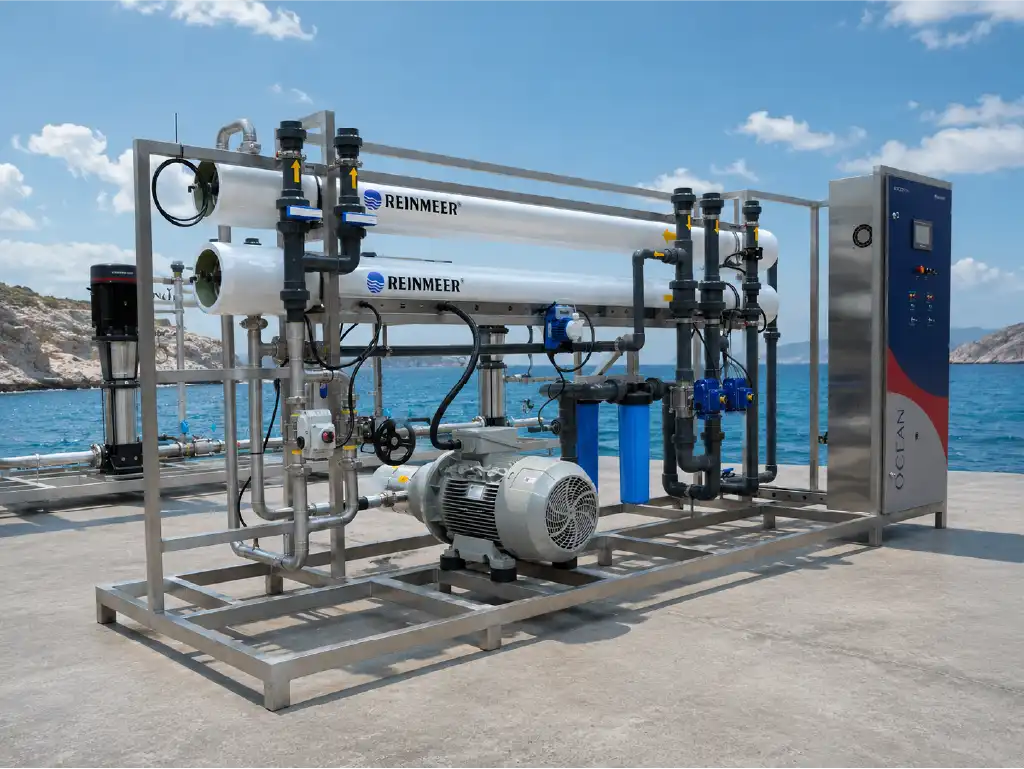
At this stage, the feed-flow and quality envelope required by the Reinmeer Seawater Reverse Osmosis system is defined. Once product capacity, target recovery, pretreatment losses, standby allowance, and operating hours are known, the design duty of the seawater intake system can be calculated. The intake should not be optimised independently from the SWRO skid; the final decision must consider the complete process from the sea to the product-water tank.
Geological Suitability, Coastal Conditions, and Permits
When a beach-well SWRO intake structure is considered, geophysical surveys, exploratory drilling, grain-size distribution, permeability measurements, and pumping tests are essential. Thick and transmissive sand or gravel may be favourable, whereas clay, low-permeability rock, or weak connection with the sea can restrict yield. If many wells are needed, land, collection piping, controls, and maintenance requirements can grow quickly.
An open-ocean intake requires evaluation of water depth, offshore distance, seabed slope, sediment movement, vessel and anchor traffic, storm waves, and the method used to stabilise or bury the pipeline. The approach velocity and opening size at the intake screen affect hydraulic loss as well as interaction with marine life. Pipelines may need burial, concrete weighting, anchors, or external protection. Where access is difficult, backwashing, air-burst cleaning, removable screens, or mechanical maintenance arrangements should be incorporated from the beginning.
Permitting requirements depend on the jurisdiction and project scale. Coastal construction consent, seabed-use rights, environmental impact assessment, water-abstraction approval, building permits, and ecological studies may all apply. Open-ocean designs generally require specific assessment of organism impingement on screens and entrainment of smaller organisms into the system. Beach wells can reduce direct marine interaction, but drilling permits, groundwater rules, aquifer impacts, and coastal land rights become more important. Permitting time should be treated as part of the project schedule, not as an administrative task after design.
Comparing Capital, Pretreatment, and Maintenance Costs
Capital costs for an open-ocean intake may include the offshore pipeline, intake head, screens, marine excavation or installation, pumping station, electrical supply, corrosion-resistant materials, and pipeline protection. A small project on a sheltered shoreline is fundamentally different from a high-capacity plant with a long intake line and heavy wave loading. Specialist vessels, divers, limited weather windows, and subsea construction can create both cost and schedule uncertainty.
Beach-well expenditure includes investigations, test drilling, production wells, screens and casings, submersible pumps, collection headers, controls, and the well-field site. A successful field may lower coagulant demand, membrane-pretreatment load, backwash volume, and sludge generation through stable feedwater quality. Conversely, low-yield wells, pump failures, corrosion, biological clogging, mineral scaling, or frequent rehabilitation may produce a higher lifecycle cost than expected. A subsurface option should not be declared economical merely because it avoids offshore construction.
Pretreatment is central to the comparison. Open-ocean feed may require screening, coagulation, dissolved-air flotation, media filtration, or ultrafiltration in different combinations, depending on the risk profile. Beach-well feed with low particulate loading may permit a simpler line, but dissolved iron, manganese, gases, or hardness can require other processes. When the SWRO intake structure and pretreatment plant are engineered together, the project is less likely to oversize unnecessary equipment or overlook a site-specific contaminant.
A robust financial model compares capital cost, annual power, chemicals, labour, marine operations, well rehabilitation, monitoring, downtime, redundancy, and future expansion over the same period and in the same currency. An offshore blockage may require divers and suitable weather; a well may need lengthy rehabilitation after losing specific capacity. Net-present-cost and sensitivity analyses can therefore show why the lower-priced SWRO intake structure may become more expensive over ten or twenty years. The preferred alternative is the one that supports the required water quality and plant availability under realistic site variability.
Frequently Asked Questions
Are beach wells always better than an open-ocean intake for SWRO?
No. A beach well can deliver low-turbidity, stable feedwater where geology is suitable, but it may fail to provide the required yield in a low-permeability formation. Open-ocean intake can be more practical for large capacities or unsuitable coastal aquifers. Testing and lifecycle analysis should guide the choice.
How deep should an open-ocean intake be installed?
There is no universal depth. Bathymetry, minimum water level, wave action, seabed movement, marine ecology, navigation, and maintenance access must be assessed together. The intake head requires adequate submergence and suitable clearance from the seabed to maintain hydraulic reliability.
Does a beach well eliminate SWRO pretreatment?
Usually not. Natural filtration may reduce particles and biological loading, but cartridge filtration, disinfection, pH control, iron removal, manganese removal, oxidation, or degassing may still be needed. The final process must follow representative water analysis and, where appropriate, pilot testing.
Which investigations are needed for an SWRO intake structure?
Salinity, temperature, turbidity, SDI, suspended solids, organic carbon, algae, microbiology, boron, silica, iron, manganese, and other site-critical parameters should be analysed. Beach wells also require hydrogeological testing, while offshore systems need bathymetric, wave, current, ecological, and sediment studies.
How is the most economical intake option identified?
Capital cost alone is insufficient. Pretreatment, power, chemicals, consumables, offshore maintenance or well rehabilitation, downtime, monitoring, redundancy, and expansion should be compared over a common lifecycle. A technically unreliable low-cost intake may be the most expensive option in operation.
Define the Right Intake with Reinmeer Engineering
The right SWRO intake structure is selected not merely to move seawater, but to support stable flow, manageable pretreatment loading, reliable membrane operation, and predictable lifecycle cost. Reinmeer Water Treatment Systems evaluates coastal conditions, representative feed analyses, target capacity, power availability, environmental constraints, and maintenance organisation together when comparing open-ocean intake and beach-well alternatives.
If you are planning a new desalination investment, experiencing seasonal instability at an existing intake, or seeking to reduce pretreatment cost, you can contact the Reinmeer engineering team through Tuna Desalination. Following a project-specific review, the team can define the intake concept, pretreatment train, redundancy philosophy, and suitable Reinmeer Ocean Series configuration. Your investment decision can then be based on an integrated technical and commercial assessment focused on dependable water production rather than on the purchase price of an isolated component.
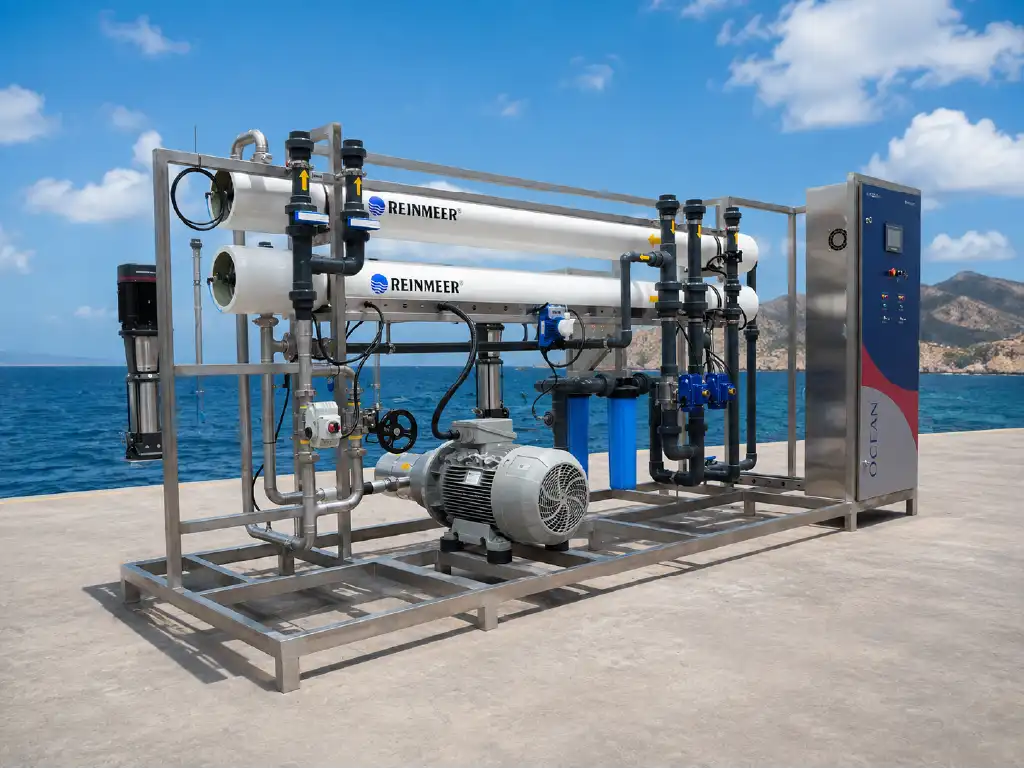
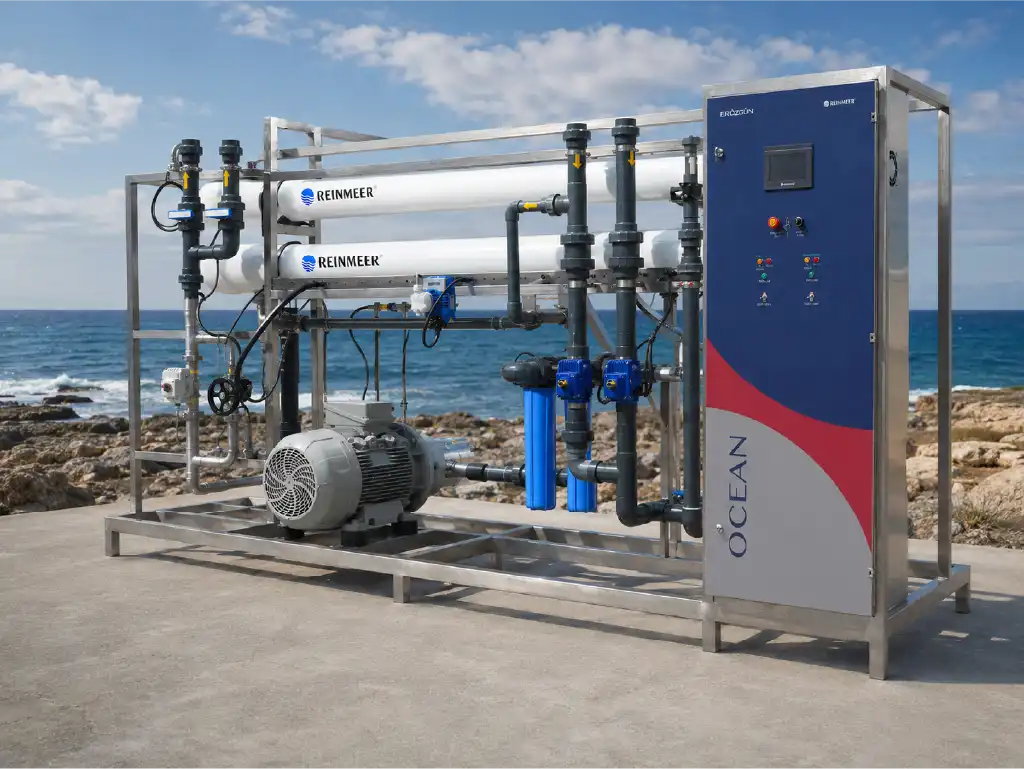
Images are representative and were created using artificial intelligence.