
SWRO Pretreatment Selection: A Membrane Protection Guide for Seawater Reverse Osmosis Systems
Haziran 15, 2026
SWRO Conductivity Increase: Why Does Product Water Conductivity Rise? Membrane and Sensor Inspection Guide
Ağustos 9, 2026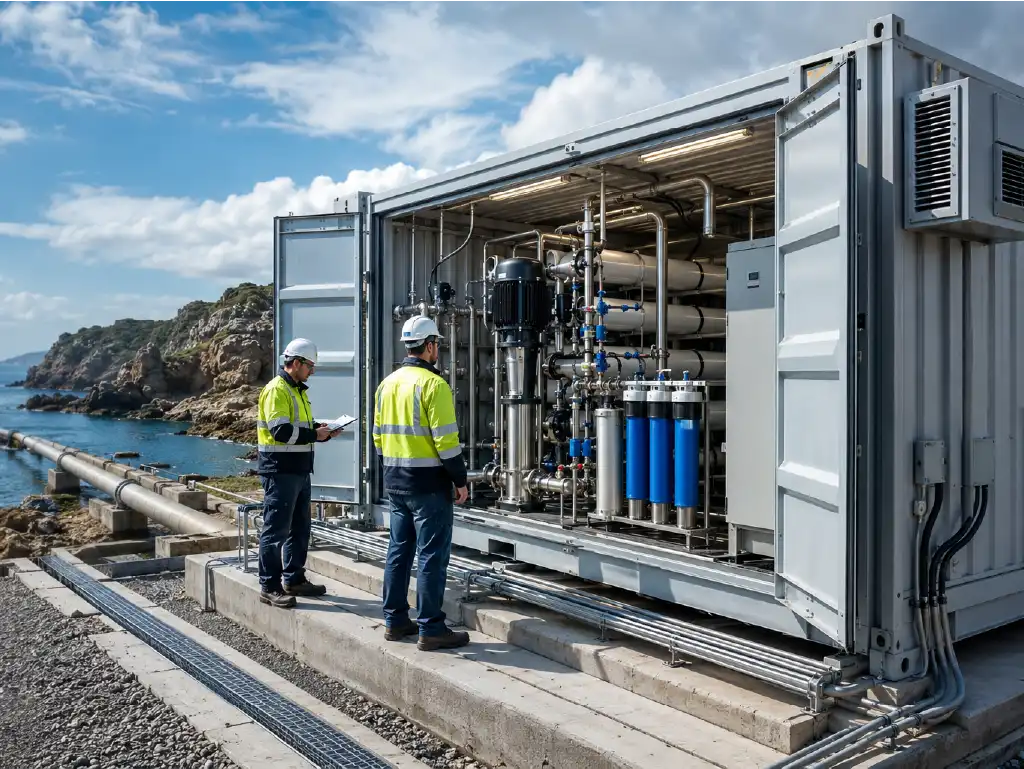
A containerized seawater desalination system installation is not a simple process completed by merely placing the unit at the project site. For the system to operate efficiently, safely, and reliably over the long term, numerous details must be clarified before installation, from electrical infrastructure and the seawater intake line to drainage and operator training.
When a containerized SWRO system is selected for coastal facilities, construction sites, islands, tourism investments, or temporary settlements, proper site preparation shortens the commissioning process and reduces operational risks.
Reinmeer Water Treatment Systems focuses not only on supplying equipment for seawater desalination projects but also on project-specific technical analysis and system designs adapted to local site conditions. A significant part of the success of mobile seawater desalination solutions depends on the engineering decisions made before the container arrives at the site.
This guide presents the main points that investors, technical teams, and project managers should review before installation in the form of a practical checklist.
The basic principle behind producing potable or utility water from seawater is the separation of salts and minerals from the water. According to the U.S. Department of Energy’s desalination resources, desalination technologies remove salts and other minerals from water to make it suitable for human consumption, irrigation, and industrial applications.
However, before a containerized seawater desalination system installation, the characteristics of the seawater, coastal structure, available energy supply, discharge permits, and daily water consumption profile must be evaluated together.
Which Projects Benefit from Containerized SWRO Systems?
Container-type seawater treatment systems provide significant advantages for projects where constructing a conventional reinforced-concrete water treatment building would take too long or would not be economically feasible.
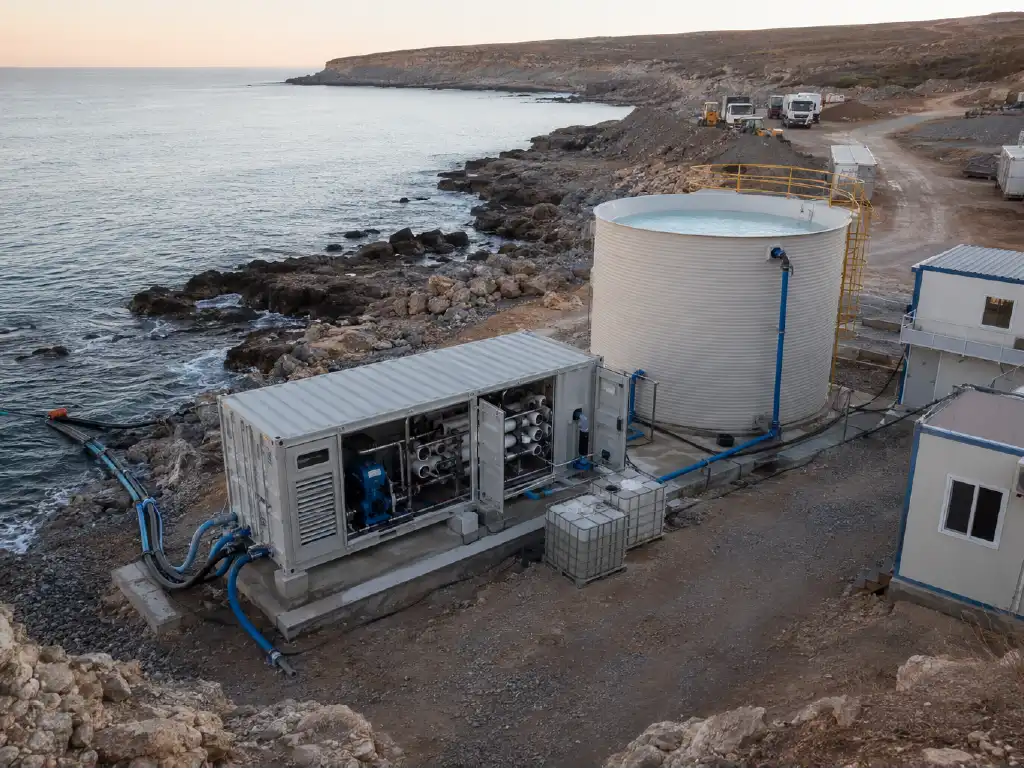
These systems bring water treatment equipment together inside an organized, protected, and transportable container structure. This approach is especially beneficial for projects with an urgent water requirement or where the treatment facility may need to be relocated in the future.
Reinmeer’s containerized seawater desalination systems can be designed to require minimal on-site installation. Because assembly and testing can be completed in a controlled factory environment, the site commissioning process becomes more manageable once the electrical, feedwater, product water, and discharge connections are prepared.
Therefore, when planning a containerized SWRO system installation, both the mobility of the system and the readiness of the site connections must be evaluated.
Construction Sites, Islands, Coastal Facilities, and Temporary Settlements
Clean water demand begins quickly at construction sites and may fluctuate throughout the project. Personnel consumption, equipment washing, dining facilities, shower areas, and administrative buildings all affect daily water requirements.
At a coastal construction site without fixed water infrastructure, a containerized SWRO system installation can reduce the need to transport water by tanker.
Islands and coastal settlements face similar challenges. In regions where municipal water is limited or logistics costs are high, a containerized SWRO system increases the facility’s independence by enabling on-site water production.
Hotels, marinas, fisheries, industrial sites, and temporary settlements are among the projects where this approach can be applied.
System capacity should not be designed solely according to current consumption. Peak-season demand and future growth scenarios must also be considered. A coastal hotel and an industrial facility operating at a constant rate throughout the year cannot be evaluated using the same criteria.
For Seawater Reverse Osmosis (SWRO) Systems, the required daily flow rate, product water quality, feedwater characteristics, energy infrastructure, and intended use must be clarified at the beginning of the project.
Fast Installation and Relocatable Investment Advantages
When containerized treatment site preparation is completed correctly, a containerized SWRO system installation can follow a shorter and more predictable schedule than a conventional treatment plant installation.
With the Reinmeer approach, equipment layout, piping, electrical panels, automation, and certain testing procedures are completed during the manufacturing stage. This makes the scope of on-site work clearer and easier to manage.
The relocatable nature of the investment should also be evaluated from a long-term perspective. When a project is completed or the water demand shifts to another location, the containerized treatment system can be repositioned.
Before transportation, membrane preservation procedures, mechanical securing, drainage emptying, and electrical safety measures should be planned by a qualified technical team.
| Project Scenario | Main Requirement | Containerized SWRO Advantage | Critical Pre-Installation Check |
|---|---|---|---|
| Coastal construction site | Fast and uninterrupted utility water supply | Transportable structure and short on-site installation | Electrical capacity, seawater intake line, and drainage |
| Island settlement | Water production independent of logistics | On-site production and capacity flexibility | Feedwater quality, storage capacity, and discharge permits |
| Hotel or tourism facility | Reliable water source during peak season | Operational continuity and automated monitoring | Daily consumption analysis and product water storage |
| Emergency or temporary camp | System that can be commissioned quickly | Plug-and-play water treatment approach | Generator capacity, ground stability, and operator training |
Infrastructure Checks Before Containerized SWRO System Installation
Before a containerized SWRO system installation, site infrastructure should not be evaluated only in terms of the physical area where the container will be positioned.
The electrical supply, ground load-bearing capacity, feedwater intake point, product water tank, concentrate discharge, ventilation, maintenance access, and occupational safety requirements must all be addressed within the same plan.
Sending equipment to the site before completing these checks may extend the commissioning period and result in additional costs.
A standard checklist can be used for every project, but it must be adapted to the specific site conditions. Waves, sediment, algae, sand, suspended solids, and temperature variations in seawater can all affect system performance.
For this reason, containerized water treatment site preparation should be supported by an on-site survey and feedwater analysis whenever possible.
Electrical Power, Ground, Drainage, and Ventilation Preparation
Electrical infrastructure is one of the most critical preparation requirements for a mobile SWRO system.
High-pressure pumps, pretreatment pumps, chemical dosing pumps, automation panels, lighting, air-conditioning units, and ventilation equipment must all be included in the same energy plan.
The required voltage, phase configuration, cable cross-section, grounding, panel protection, and generator scenario must be clarified before installation.
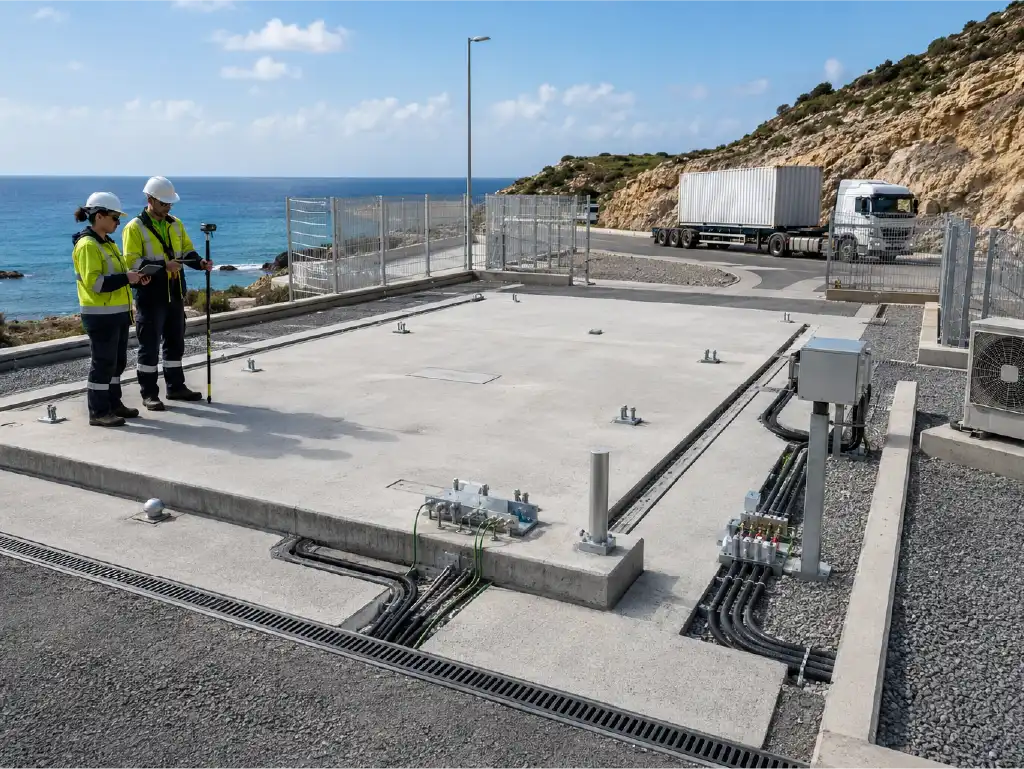
Ground preparation is equally important. The area where the container will be placed must be level, have sufficient load-bearing capacity, remain protected against water accumulation, and allow access for service vehicles.
Depending on the project, the foundation may consist of a concrete platform, a steel structure, or properly compacted ground. For coastal projects, corrosion risk, wind load, and storm impact must also be evaluated.
The drainage line should be designed to safely remove washing water, filter backwash water, and cleaning liquids that may be generated during maintenance.
Flooding inside the container, continuous moisture beneath the equipment, or improper liquid accumulation in chemical areas can increase long-term maintenance costs. Drainage slopes, collection points, and the discharge route must therefore be checked before installation.
Ventilation and climate control are necessary for the safe operation of equipment inside the container.
At coastal sites, temperature, humidity, and salty air can damage electrical panels, sensors, and metal components. Reinmeer’s approach to seawater treatment technology and system safety evaluates automation, material selection, energy efficiency, corrosion resistance, and operational safety together.
Seawater Intake Line, Feedwater Tank, and Concentrate Discharge
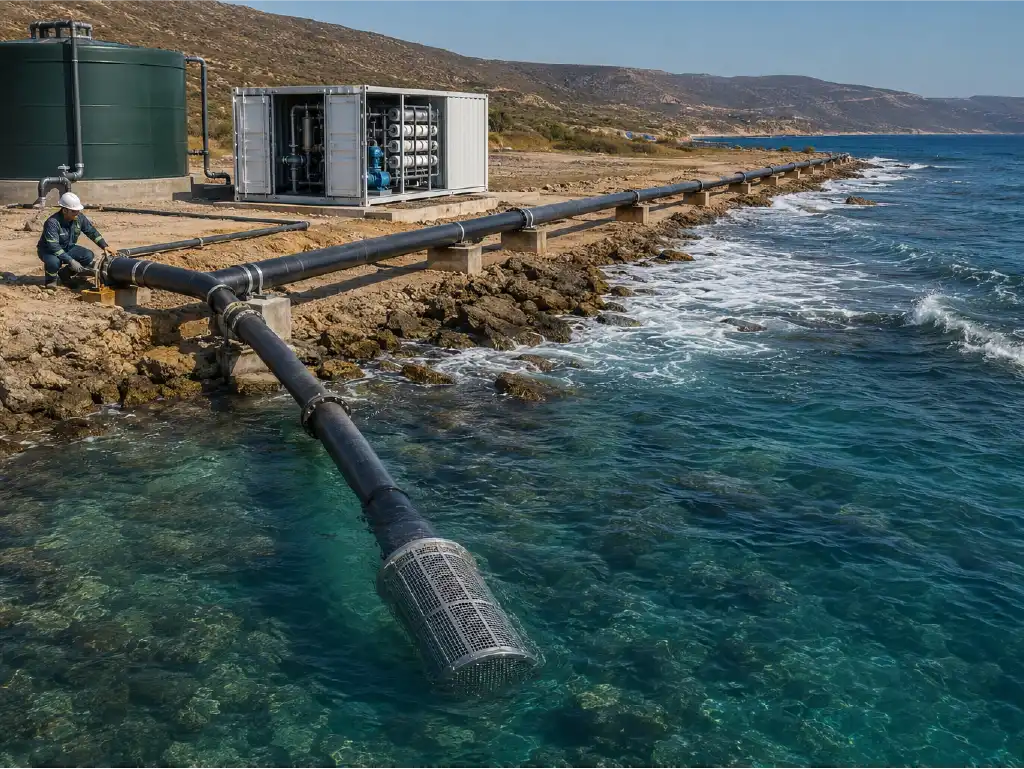
The seawater intake line is the system’s first point of contact with the raw water and plays a major role in determining the overall treatment quality.
When the intake point is positioned too close to the surface, exposure to algae, oil, foam, and wave action may increase. When it is positioned too close to the seabed, the risk of drawing in sand and sediment becomes higher.
Before the containerized SWRO system installation, the intake point should therefore be positioned at a suitable depth and designed with a protective screen.
A feedwater tank helps reduce the system’s exposure to fluctuating sea conditions. Its capacity should be determined according to the system output, pump flow rate, and pretreatment configuration.
A feedwater tank with insufficient capacity can increase the risk of dry pump operation or flow fluctuations. The tank inlet and outlet arrangement should minimize sediment accumulation, and a regular cleaning plan should be established.
Concentrate discharge must be evaluated from both technical and environmental perspectives.
SWRO systems generate a concentrated saline stream. The destination, flow rate, and discharge conditions of this stream must be planned according to applicable regulations, local permits, and environmental sensitivities.
For a general example of how point-source water discharges may be managed through a government permitting framework, the U.S. Environmental Protection Agency’s NPDES overview can be reviewed. The specific legal and technical requirements applicable to the project location must always be confirmed with local authorities.
Back pressure, marine currents, coastal use, and maintenance access should be considered when designing the discharge line.
Expert note: The term “plug-and-play water treatment” does not mean that the system requires no site preparation. The equipment inside the container may already be installed, but safe commissioning cannot be expected until the electrical, feedwater, product water, drainage, and concentrate discharge connections have been prepared specifically for the site.
Technical Checklist Before Commissioning
Commissioning is one of the most critical quality-control stages of a containerized SWRO system installation.
The purpose of commissioning is not simply to confirm that the system operates. It must also demonstrate that the system performs according to its design parameters.
Pressure, flow rate, conductivity, pH, chemical dosing values, automation alarms, and safety equipment must be tested in a controlled manner.
The first start-up should not be rushed. Starting the high-pressure pump before completing pretreatment flushing, cartridge filter inspections, membrane preservation procedures, and pipeline cleaning may negatively affect membrane service life.
A containerized SWRO system installation should therefore proceed according to the manufacturer’s instructions, site analysis results, and the technical team’s commissioning documentation.
Membrane, Pump, Filter, and Chemical Dosing Checks
Membranes are the heart of an SWRO system.
Before commissioning, the membrane pressure vessels, flow directions, seal positions, product water lines, and concentrate lines must be checked.
When the system has remained without power for an extended period, the membrane preservation solution, storage conditions, and initial flushing procedure must also be reviewed.
The first volume of product water may need to be directed to the drain for a specified period instead of being supplied directly for use.
For pumps, the rotation direction, mechanical seal, suction pressure, discharge pressure, vibration, noise, and electrical current values should be checked.
The high-pressure pump must not be operated outside its design pressure range. Valve positions and bypass lines should also be verified before the first start-up.
Depending on the seawater characteristics, the filtration system may include sand filters, multimedia filters, activated carbon filters, cartridge filters, ultrafiltration, or a combination of different pretreatment technologies.
Before commissioning, the filter media, automatic valve sequence, backwash duration, differential pressure, and cartridge filter micron rating must be checked.
When the pretreatment system does not operate correctly, membrane fouling and the need for chemical cleaning increase.
During a containerized SWRO system installation, the chemical dosing process may include antiscalant dosing, pH adjustment, chlorine removal, CIP chemicals, and final disinfection when required.
Simply checking the chemical tank level is not sufficient. Each dosing pump must be calibrated.
- The electrical panel, circuit breakers, grounding, and phase sequence should be checked.
- The directions of the feedwater, product water, and concentrate discharge lines should be verified.
- All pretreatment backwashing procedures should be completed before commissioning.
- Conductivity, flow, pressure, pH, and temperature sensors should be calibrated.
- Alarm and automatic shutdown scenarios on the control system should be tested.
- The operator’s daily inspection form should be available at the project site.
Operator Training, Maintenance Access, and Spare Parts Planning
Even a well-designed system cannot deliver the expected performance when it is not operated correctly.
Operator training should therefore be planned before the containerized SWRO system installation is considered complete.
The training should include practical instruction on the system’s basic operating principle, daily control parameters, alarm screens, chemical safety, filter replacement, cleaning procedures, and emergency shutdown steps.
Maintenance access must be considered during the design and positioning stages.
There should be sufficient space inside and around the container to remove membrane pressure vessels, service pumps, replace filters, access chemical tanks, and open the electrical panel safely.
When the system is positioned too close to a wall, fence, or another structure, maintenance time may increase and occupational safety risks may arise.
Spare parts planning is essential for operational continuity.
A basic spare parts inventory should be created for cartridge filters, seals, pressure sensors, dosing pump diaphragms, conductivity probes, and critical valve components.
For projects in remote locations, the expected service response time should also be evaluated.
Practical Checklist for Containerized Water Treatment Site Preparation
The following checklist has been prepared to support site teams during the pre-installation assessment of mobile seawater desalination projects.
It provides a general framework. The final decisions should be based on feedwater analysis, capacity calculations, an on-site survey, and project-specific engineering evaluations.
- Have the daily and hourly water consumption requirements been calculated?
- Has the raw seawater been analyzed?
- Have seasonal changes in feedwater quality been evaluated?
- Are the required electrical power, generator capacity, grounding, and panel protection available?
- Has a level and secure foundation with suitable service access been selected for the container?
- Have the diameter and depth of the seawater intake line been determined?
- Have pump suction conditions and the intake screen design been planned?
- Are the feedwater tank and product water tank capacities suitable for the operating scenario?
- Have the concentrate discharge route, environmental permits, and technical connections been clarified?
- Are drainage, ventilation, air-conditioning outdoor unit space, and maintenance clearances ready?
- Have a suitable chemical storage area, safety labels, and personal protective equipment been provided?
- Has a periodic maintenance and remote technical support plan been created for the post-commissioning period?
This checklist is an effective starting point for reducing delays during a containerized SWRO system installation.
However, because feedwater quality and the intended use of the treated water vary from one seawater desalination project to another, the system should be selected through a technical analysis carried out by an experienced engineering team rather than by choosing a standard unit.
Reinmeer develops project-specific seawater treatment solutions for hotels, villas, residential complexes, social facilities, offshore platforms, coastal settlements, construction sites, and industrial applications.
Frequently Asked Questions
Where Can a Containerized Seawater Desalination System Be Installed?
A containerized seawater desalination system can be installed at coastal construction sites, islands, hotels, marinas, industrial facilities, temporary camps, and emergency settlements with access to seawater.
For a containerized SWRO system installation, the site must have level ground, suitable electrical infrastructure, access to a feedwater intake point, a concentrate discharge line, and sufficient maintenance access.
What Infrastructure Is Required for a Mobile SWRO System?
A mobile SWRO system requires an electrical supply, seawater intake line, feedwater tank, product water tank, concentrate discharge line, drainage, ventilation, and a safe maintenance area.
Suitable chemical storage areas and operator safety equipment must also be planned.
How Long Does It Take to Commission a Containerized Treatment System?
The duration of a containerized SWRO system installation and commissioning process depends on the system capacity, site preparation, electrical and piping connections, feedwater analysis, and testing procedures.
A factory-assembled containerized SWRO system can be commissioned more quickly when all site connections are ready. However, the exact duration must be evaluated individually for each project.
How Should the Seawater Intake Line Be Planned?
The seawater intake line should be planned according to the intake depth, sand and sediment risk, algae concentration, wave action, pipe diameter, pump suction conditions, and maintenance access.
Using a protective screen at the intake point is recommended. A feedwater tank can also help protect the system against flow fluctuations.
Can a Plug-and-Play Water Treatment System Operate Without Site Preparation?
No. A plug-and-play water treatment system means that the equipment has already been arranged and installed inside the container. It does not mean that site connections are unnecessary.
The electrical supply, feedwater line, product water line, drainage, concentrate discharge, and operator preparations must be completed before the system can be operated safely.
Plan the Right Containerized SWRO Solution for Your Project with Reinmeer
When investing in seawater desalination, proper preparation of the installation site is just as important as choosing the correct equipment.
For coastal facilities, islands, construction sites, tourism investments, and temporary settlement projects, Reinmeer Water Treatment Systems evaluates the entire process on a project-specific basis, from capacity calculations and site layout to seawater intake design and commissioning planning.
You can review Reinmeer seawater desalination products to compare solutions developed for different capacities, installation areas, and operating conditions.
For technical surveys, engineering analysis, system selection, capacity calculations, or quotation support related to a containerized SWRO system installation, you can contact Reinmeer’s engineering team and request a project-specific assessment.